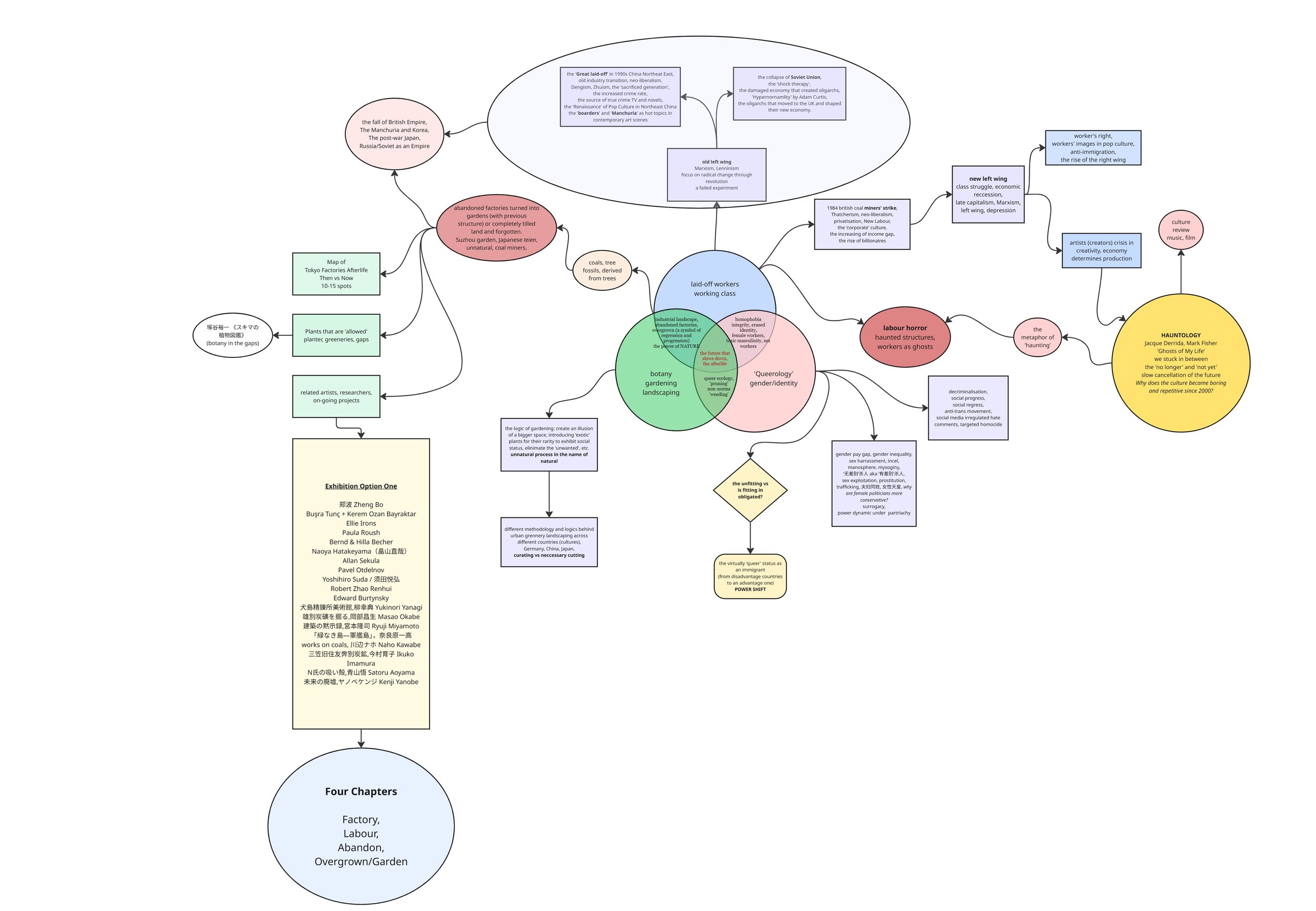
This is a phased summary of my ongoing research project. I used my residency in Tokyo (from September to November 2026, at Tokyo Arts and Space) to expand the idea and explore more possibilities.
Origin: My three personal favourite topics: 1) working class, unemployment, industrialisation and de-industrialisation. 2) Botany, either planting my own things or being nerdy about taxonomy. 3) Queer identity, including its history, its existence in different cultures, and how society targets queer people (whenever there is a crisis).
My ‘cooking’: I always think that one's favourite topics must have something in common, just as the things one hates must overlap in many different ways. They can't be without reason or random. So I made a mind map and listed it below. It is only temporary and will expand more in the future. It all started with the Venn diagram with the three circles.
Summary and connection:
When working-class people were still hired, they were depicted as national heroes and a source of ‘pride’, and once they were laid off, they became ‘the problem’: violent, alcoholic, abusive, toxic, and even racist and homophobic. It is almost as if they were ‘castrated’ by the authorities and dumped. Masculinity at this point has become a greater problem. See examples from the UK in the 1980s or China in the 1990s, and how this reshaped the countries’ images and pop culture. At the same time, female workers were overlooked, and queer workers were either deep in the closet or could not be mentioned, as if they were not part of the ‘glory days’.
Plants grow and die in their own way. Humans took them inside as gardening, ikebana and decorative elements, then hybridised, bred and artificially selected them, eventually creating an abundant garden culture. They selectively divided plants into ‘good ones’ and ‘weeds’, and intervened in the way they grow, curbing, curling, twisting and pruning them to cater to human eyes. It also indicates how different cultures see them and shows how they perceive ‘unharmoniousness’. Are the green spaces on the side of the road replaced four times a year to create a ‘show’? Or is the overgrown actually local and healthy? How much ‘weed’ shall we tolerate? You don't have to have sympathy for plants, but the idea of ‘removing’ should be concerning you as well.
Weirdly, queer people were associated with plants and green thumbs during the COVID pandemic, and of course, also before that, when stereotypical queer people always took good care of their gardens. At the same time, queerness is targeted whenever the ‘mainstream’ encounters a crisis (mostly created by itself).
Method:
If criticising A is taboo or a political forbidden zone, artists and curators need to invent new methods to ‘provoke’ it, either by using metaphor, analogy, mirroring reality, parallel events, etc. In this way, botany, queer identity and the working class can work as a whole. Combining AB to address C, combining BC to address A. A stable triangle, if you may. That is why there are so many different ways to code your message and broadcast it under the radar.